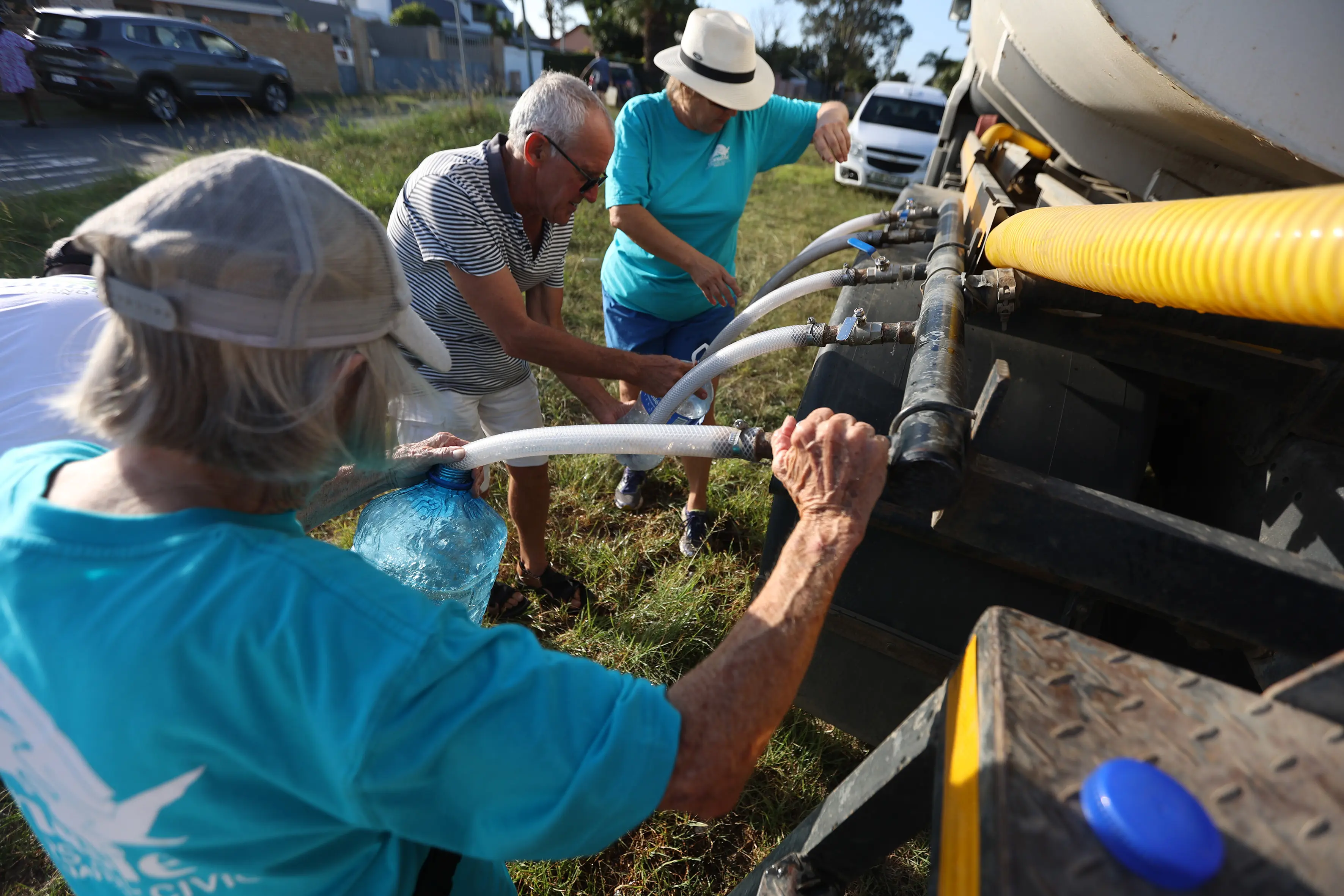
SA has been confronted with water security challenges for decades, and they came to a head in the weeks leading up to the 2026 local government elections.
Communities across the country have been engaged in sustained protests over water outages and dry taps, with some openly declaring that they would not be casting their votes due to years of unresolved water challenges.
During the elections two weeks ago, several voting stations across the country experienced water shortages, creating challenges for IEC officials, election personnel and voters.
Various organisations, including Gift of the Givers, were compelled to provide water storage tanks on loan across various voting stations for the three-day voting period.
This is how serious the situation has become.
In August 2023, the Association of Water and Sanitation Institutions of South Africa (AWSISA) was formally registered as a nonprofit company.
The association acts as a unified strategic voice and platform for co-ordination, policy reform, legislative compliance, and integrated water resource management among South African water boards and sanitation institutions.
This weekend, the 2nd AWSISA Africa & Global South Water and Sanitation Dialogue is taking place in Durban.
It will be convening policymakers, utilities, private sector innovators and development partners to accelerate practical responses to climate pressure, infrastructure investment and universal access.
Through technical sessions, strategic partnerships and shared implementation models, the dialogue will be looking to aid in facilitating resilient systems and sustainable outcomes across the African water value chain.
This dialogue is crucial for SA, particularly for our municipalities, which lose about 47% of their total drinking water as non-revenue water (NRW).
NRW refers to water that is treated and distributed but never billed or accounted for.
About 40.8% of this non-revenue water represents physical water losses. These are losses that result from leaks and burst pipes.
The primary causes of this are ageing and burst underground pipes, unattended leaks, illegal connections, faulty or unread water meters and poor municipal maintenance.
While the situation is dire across much of the country, it is especially catastrophic in the Eastern Cape.
NRW has reached critical levels in Nelson Mandela Bay and has surged to between 47% and more than 60%, with recent estimates and municipal tracking placing losses at roughly 60% to 60.4%.
This far exceeds the acceptable benchmark rate of 25% for urban municipalities.
About three in 10 families in the province lack access to an improved water source, with rural communities in districts like Alfred Nzo, OR Tambo (including Qumbu) and Amathole (Ngqamakwe and Butterworth) forced to rely on natural springs, contaminated rivers and shared animal watering holes.
Municipal water systems in areas like Makana and Mthatha have faced contamination issues, including high levels of E. coli and bacteria in tap water.
This has led to health risks, such as gastrointestinal infections.
Over the years, AWISA has put practical solutions on the table for how to strengthen water governance and equity in SA.
Some of these, such as the need for municipalities to ring-fence budgets specifically for water and sanitation, are only now starting to be part of the discourse in government, with President Cyril Ramaphosa having recently emphasised that this must be done as a means to fund infrastructure maintenance rather than operational expenses.
This was echoed in the White Paper on Local Government that was launched just a week before elections and is also proposed in the National Water Action Plan (NWAP) that was released in July 2026.
Residents, media, academics and activists in the Eastern Cape must pay close attention to the AWSISA dialogue because it will shape what demands they can make from their municipalities as they continue to fight for good governance and universal access to water.
Malaika wa Azania is a writer, political commentator, author and columnist