

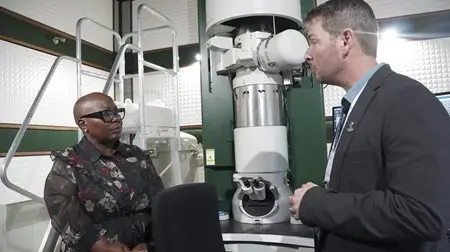
The deputy minister of science, technology and innovation, Dr Nomalungelo Gina, popped into the friendly city recently to inspect new infrastructure at Nelson Mandela University that marked the renewal and expansion of microscopy research in SA.
The deputy minister of science, technology and innovation, Dr Nomalungelo Gina, popped into the friendly city recently to inspect new infrastructure at Nelson Mandela University that marked the renewal and expansion of microscopy research in SA.
Gina was on hand to unveil two new scanning electron microscopes (SEMs) that offer greater stability, faster acquisition, substantially stronger signals, and sharper images than the predecessor equipment at the university’s Centre for High Resolution Transmission Electron Microscopy (CHRTEM).
Gina joined the centre based at Mandela University’s south campus on Thursday as part of its 15th anniversary celebration.
The CHRTEM was established in 2011, with R90m funding from the department of science, technology and innovation (DSTI) and its entity, the National Research Foundation (NRF).
The department of higher education and training (DHET) provided R30m towards the centre’s building.
Gina remarked that the unveiling underscored the continued evolution and renewal of national research infrastructure, directly aligned with the NRF and DSTI’s strategic priorities.
“The 15th year is not simply a moment to celebrate what has been built, but to commit to ensuring that SA remains equipped to see, measure, understand and engineer matter at the scales at which the technologies of tomorrow are being developed."
Professor Jaco Olivier, director of CHRTEM, took the deputy minister through the centre, detailing its history and key milestones.
Olivier explained that the centre uses SEMs extensively to study structural materials, particularly steel and aluminium alloys.
He said the two new SEMs represent a strategic phase of infrastructure renewal as CHRTEM’s original instruments approach the end of their factory support.
“The acquisition substantially expands Nelson Mandela University’s capabilities in advanced scanning electron microscopy and interdisciplinary bioimaging,” he said.
The other significance is the expansion of the centre’s capabilities beyond traditional materials sciences into biomedical imaging and the bioeconomy.
It also positions CHRTEM for the next 15 years of technological challenges and sustains the commitment of the DSTI, the NRF and the University to national research infrastructure.
Speaking at a gala dinner celebration later in the day, Gina paid tribute to the partnership, including industry partners such as Sasol, Element Six, and Pebble Bed Modular Reactor, for co-investing with government over the years, saying CHRTEM has held a unique and profound distinction.
During the period, the facility logged over 40,000 microscope hours, 1000 students supported and trained, conducted more than 700 research projects, serving as a critical engine for SA’s system of innovation.
The deputy minister said science in Africa was growing persistently, welcoming the news that Morocco was currently installing its own advanced aberration-corrected microscopy infrastructure.
“We celebrate this expansion of advanced scientific infrastructure across the Global South.
"It validates the path we chose 15 years ago and opens new doors for African leadership and collaboration in the global scientific arena,” she said.