

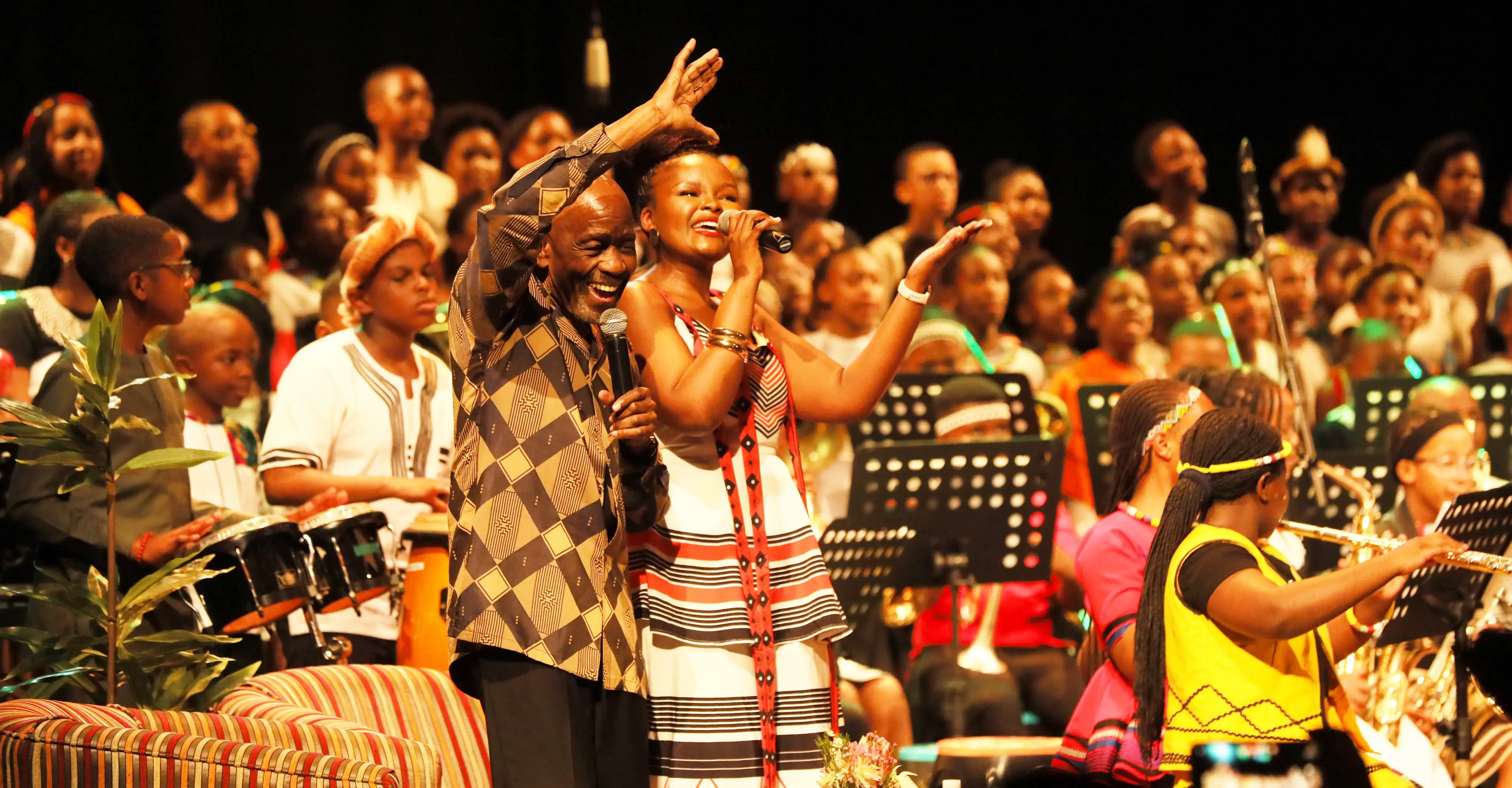
Legendary South African musician Caiphus Semenya brought the audience at the Mandela Bay Theatre Complex to its feet during a special heritage concert alongside pupils from Greenwood Primary School. At 87, the jazz icon showed remarkable energy on stage while revealing a major new initiative.
SummaryOpen the quick read
- Jazz maestro Caiphus Semenya delivered a celebrated performance alongside primary school pupils at the Mandela Bay Theatre Complex in Gqeberha.
- Semenya announced a strategic partnership between Greenwood Primary School and his Soweto-based National Academy of Africa’s Performing Arts.
- The initiative aims to harness Greenwood's proven music education methods to train instructors at the new Soweto institution.
- Greenwood Primary's music department is constructing a R14.8m auditorium funded by the Alexander Music Project.
- Semenya reflected on the personal apartheid-era struggles in exile that inspired him and Letta Mbulu to establish a performing arts academy.
The crowd in the packed theatre erupted in celebration on Friday night as Caiphus Semenya performed his classic hit Ndiphendule with young jazz singer Nande Mzaidume.
People danced in the aisles, others held their cellphones aloft, lights on, as they swayed to the rhythm of the love duet made famous decades ago by the legendary musician and his wife, Letta Mbulu.
By the time Semenya and Mzaidume moved on to Angelina, another of his blockbusters, the crowd in the main auditorium of the Mandela Bay Theatre Complex was euphoric.
Wearing a gold and black Madiba-style shirt and black trousers, the maestro was energised as he danced, working the crowd, smiling and pointing at people in the first few rows.
“He still has it!” the master of ceremonies had shouted earlier, to roars of delight from the audience, after Semenya delivered a spirited rendition of Ziphi’Nkomo, a hit he composed and featured on his celebrated 1982 solo album, Listen to the Wind.
It was difficult to believe that he had turned 87 in August, or that more than 60 years had passed since he left SA for the US to escape the strictures of apartheid.
The setting for Friday night’s show was unusual.
Semenya and hugely popular singers Zain SA and Dumza Maswana had come together to perform — for free — with the children at Greenwood Primary School’s heritage concert.
The Gqeberha school’s music department celebrated SA’s rich jazz heritage by performing the songs of artists such as Miriam Makeba, Mbulu, Semenya, the Soweto String Quartet, Hugh Masekela, Abdullah Ibrahim, Marcus Wyatt and Judith Sephuma.
More surprising than Semenya’s rousing performance was the realisation that the choir, wind band, strings and full orchestra that combined to produce an evening of high-quality music were made up of primary school children, rather than professional musicians.
But on a night full of surprises, it was the old master’s announcement that he had additional business to conclude in Gqeberha that intrigued the audience.
He was in the city, he said, to cement a partnership between Greenwood Primary’s music department and the state-of-the-art National Academy of Africa’s Performing Arts in Jabulani, Soweto.
The brainchild of Semenya and Mbulu, the long-awaited academy had finally been built and was just about ready, barring the recording studio.
However, he said it was lacking in another crucial area — trained teachers who know how to teach music to young people.
“We want Greenwood to be our sister school,” Semenya said to shouts of delight from the audience.
“Gqeberha’s going to be playing the role of teaching Soweto how to teach music!”
His choice of Greenwood Primary to partner with the academy makes sense: the school’s music department has punched above its weight for years, first under the leadership of Jackie Barnardo, and more recently Libongo Ntuli, her former pupil.
The department’s reputation is bolstered by its talented staff, including Mzaidume (voice and choir), Chadley Johnson (lower brass), Matthew Shone (woodwind), Abongile Sihawu (percussion and drum kit) and Sihle Kakancu (upper strings), with Ntuli also teaching the trumpet.
Barnardo, now the deputy principal, related at a rehearsal on Thursday how she “nearly fell out of the car” when she and Ntuli were informed during a phone call in June or July by SK (her church friend Sekgaile Semenya) that his grandfather, who wanted to work with Greenwood, and who was “quite famous”, was actually Semenya.
For Ntuli and Barnardo, agreeing to collaborate with the legendary singer and composer was a no-brainer.
“Our primary focus is always to educate as teachers, but also as musicians our focus and dream is to perform on big stages,” Ntuli said.
“So, what better way to introduce kids to such a legendary character and performer such as Caiphus Semenya … whereby they get to realise … that the hard work they’ve put in, at the end of the day, it really is worth it when they get to go on stage with a giant.
“Of course, our intention is to build relations with [his] newly developed arts centre … whereby we can one day share resources and participate together in this lovely thing called music education through performances, discourse and just learning from one another.
“Our department is probably the youngest music department in terms of teachers.
“So, to get recognition from people such as Dumza Maswana and Zain SA, and to get them to collaborate and share the stage with us, is something we don’t take for granted.
“We thank them for embracing us and forming part of us and being our family.”
The nuts and bolts of the partnership with Semenya haven’t been worked out yet but Barnardo suggests it might involve a mentoring process, with the academy’s music teachers shadowing their counterparts in Gqeberha.
Greenwood Primary is also building a modern auditorium for its music pupils, thanks to a donation of R14.8m from SA-based German investor and philanthropist Alexander Valentin, the founder of the school’s strings programme, through the Alexander Music Project.
“The centre will provide our learners with a dedicated space in which to learn, rehearse and perform, and will significantly enhance the opportunities we are able to offer our music students,” Ntuli said, adding that construction was scheduled to be completed in December.
“Our strings programme currently provides learning opportunities for 30 string learners, who form part of our string orchestra, as well as a piano student.
“The learners rehearse every morning, as well as three afternoons a week.
“This level of commitment has allowed us to build a strong ensemble culture and to explore a wide variety of musical genres, from highly classical repertoire to music that is much closer to home and reflects our local musical identity.
“The success of the strings programme has also enabled us to expand our offering into a full orchestra, creating even more opportunities for our learners to perform, collaborate and develop their musicianship.”
Institutional knowledge and established programmes and teaching practices are priceless and take years to develop.
Semenya, who never received formal training and was turned away by the Manhattan School of Music in 1965 on the grounds that, at 25, he was "too old", believes the partnership with Greenwood could be a game-changer for the Soweto academy.
He was obviously impressed, during the rehearsal, by the skill and discipline of the school’s young musicians as they tackled Ziphi’Nkomo.
“These people know how to teach young people. You’ve got to have patience. Kids make mistakes.
“With adults, if it doesn’t work out you can show them the door, but you can’t do that with young people.”
During the show, he explained the thinking behind the academy, pointing to his experiences in New York, alongside those of Mbulu, Makeba, Jonas Gwangwa and Masekela, who was told, at age 20 after his Manhattan school assessment: “you’re a very, very good musician but you don’t know the trumpet”, and sent to learn the instrument with 15-year-olds.
“So, we swore that the day we go home we have to build an institution so that our children must never be exposed to that,” Semenya said.
Follow The Herald WhatsApp channel today and stay connected to the stories shaping our world.
The Herald
