

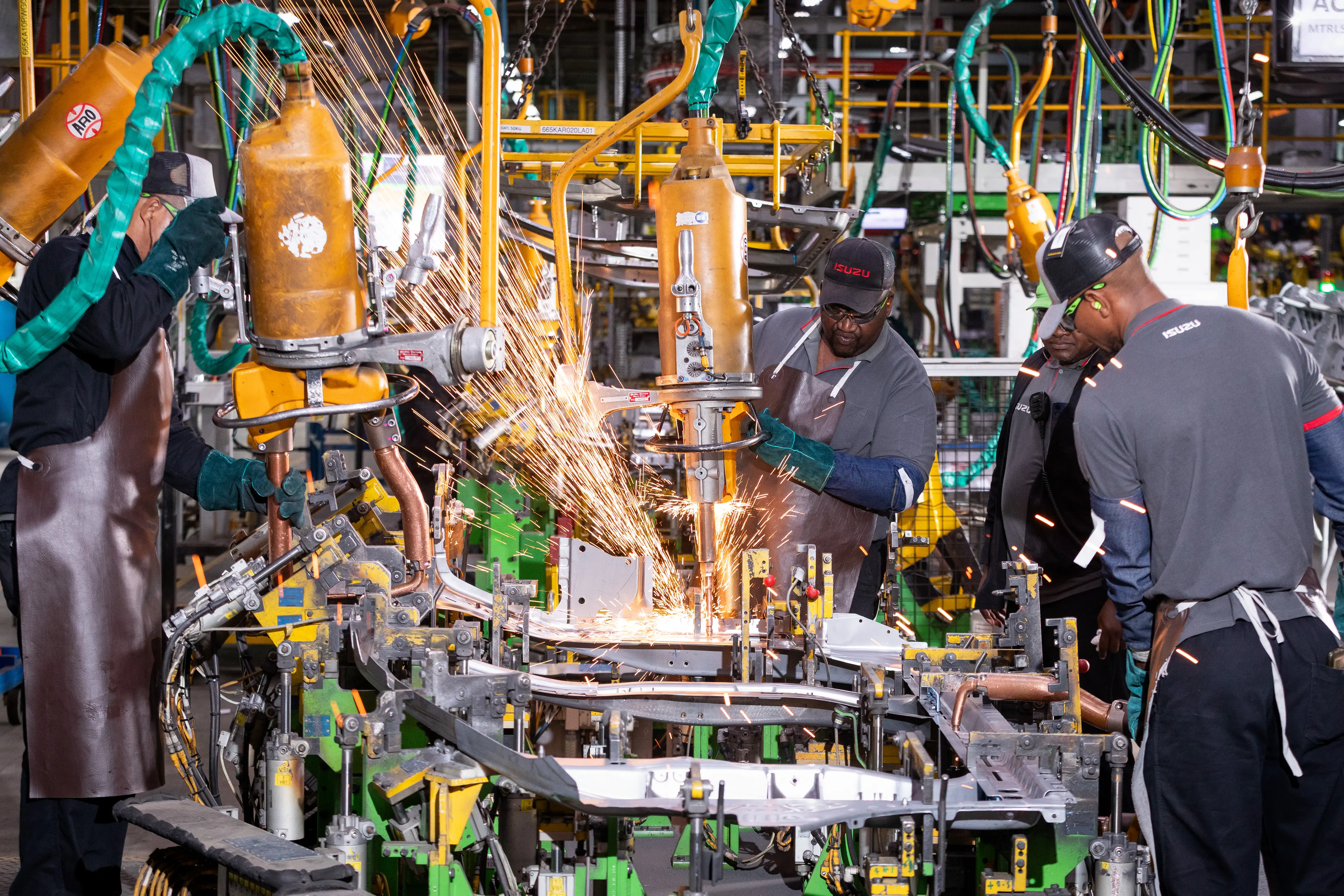
One of Nelson Mandela Bay’s biggest automotive manufacturers has put its best carbon footprint forward by simultaneously increasing production and decreasing emissions.
Isuzu Motors SA (IMSA) has reduced its Scope 1 and Scope 2 CO₂ emissions by 38% against its 2013 baseline, while increasing vehicle production by 21% during the 2025/2026 financial year at its Gqeberha manufacturing plant.
Combined Scope 1 and Scope 2 emissions intensity also decreased from 0.89t CO₂e per vehicle produced in 2024 to 0.76t CO₂e in 2025, representing a 15% year-on-year improvement.
IMSA executive vice-president: corporate services Celestin Ndhlovu said the results, detailed in IMSA’s 2026 Sustainability Report, demonstrate the company’s ability to reduce emissions intensity while expanding manufacturing output.
IMSA’s carbon footprint is independently assessed by a professional body, providing external verification of the company’s emissions measurement and reporting approach.
Ndhlovu said IMSA’s continued investment in energy efficiency, cleaner fuel technologies, process improvements and renewable energy forms part of its broader commitment to the Isuzu Environmental Vision 2050.
And it is well on its way to meeting the company’s 2030 environmental roadmap, which set a target of reducing Scope 1 and Scope 2 emissions by 50% against its 2013 baseline.
“As we expand our operations, we recognise that increased production must be supported by greater operational efficiency and a sustained focus on reducing our environmental impact,” Ndhlovu said.
“Our 38% reduction against the 2013 baseline represents significant progress towards our long-term ambitions.
“However, as production volumes increase, we must continue to strengthen our energy efficiency measures and accelerate the adoption of cleaner fuels and renewable energy to achieve our environmental targets.”
To support these objectives, IMSA has since introduced a range of operational improvements aimed at reducing emissions and enhancing manufacturing efficiency.
These include transitioning from higher-emission liquid fuels to cleaner-burning liquefied petroleum gas (LPG) in certain manufacturing operations, contributing to reductions in Scope 1 emissions.
The company has also implemented targeted energy efficiency measures that contributed to a reported 7% improvement in Scope 2 emissions performance.
These include process and chemical optimisation, equipment upgrades, enhanced energy monitoring and asset-sustainment initiatives designed to improve equipment reliability, optimise energy consumption and strengthen operational efficiency.
With electricity accounting for 69% of IMSA’s total operational emissions, transitioning to cleaner energy sources remains a critical component of its decarbonisation strategy.
In line with this, IMSA has secured an agreement with an independent power producer (IPP) for wind and solar energy, aimed at reducing its dependence on SA’s electricity grid.
Ndhlovu said IMSA is evaluating further renewable energy investments to support progress towards its 2030 target of a 50% reduction in Scope 1 and Scope 2 emissions including rooftop and ground-mounted solar photovoltaic systems supported by battery storage, alongside opportunities to increase the procurement of electricity from renewable sources.